
Control Through Planner-Conditioned Estimator Error
Belief-space planning for VTOL ship-deck landing
A planner can predict parts of an estimator's error using information the estimator does not receive. This work accounts for that predictable error and intermittent corrections when planning VTOL landings on a moving ship deck.
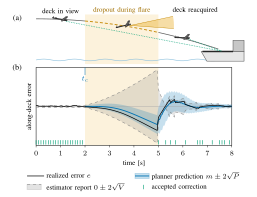
Figure 1 details and data
Predictable error through an observation dropout
Both panels share the same clock. The aircraft follows panel (a)'s authored schematic curve, with pitch interpolated between its illustrated poses; this is not measured flight motion. Panel (b) uses the paper's error samples. The aircraft holds at the drawn path's endpoint while the error plot finishes. Turn Scroll motion off to show the complete original illustration.
Abstract
Belief-space planners with separately designed or off-the-shelf estimators may have access to state-relevant information the estimator does not observe. Consequently, even an estimator that minimizes mean-squared error under its own information can have a nonzero error mean when conditioned on planner information. When future corrections are intermittent and stochastic, differences between accepted and rejected error means introduce additional uncertainty terms to correction events that zero-mean assumptions ignore. In this paper, we propose a belief-space planning approach that predicts, propagates, and penalizes planner-conditioned estimator error along evaluated trajectories. A planner-conditioned estimator-error model combines affine error dynamics with a moment recursion that preserves stochastically-induced correction uncertainty. We describe a method by which to predict estimator error dynamics within specified operating regimes and incorporate predicted error moments into a task-weighted quadratic risk objective. We evaluate the approach in simulation for a tilt-rotor VTOL landing on a ship deck using receding-horizon planning. We find that conditioning on planner information reduced error-prediction loss for a command-blind EKF by 13.4% relative to a planner-ignorant model, with strongly regime and horizon-dependent forecasting abilities. In a small set of 16 paired closed-loop trials, the planner lowered the median terminal task gauge from 1.60 to 0.99, and predicted estimator error beyond 2s within a factor of 1.3, versus a 5.7-fold underprediction by covariance-only planning.
Figures from the paper
Figure 2
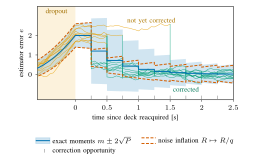
Figure 2 details and data
Possible futures after stochastic corrections
The faint sample-path markers turn from orange to green when a correction is accepted. Time advances between recorded samples without smoothing over correction jumps.
Figure 3
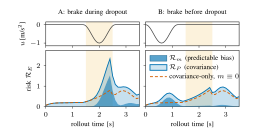
Figure 3 details and data
Compare candidate commands at a shared rollout time
Both candidates advance together. Faint markers follow the covariance-only comparison; the risk markers use the same post-correction samples as the paper.
Figure 4
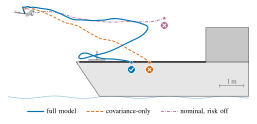
Figure 4 details and data
Replay one matched landing trial
Aircraft follow the measured simulation positions, pitch, and rotor tilt. Faint vehicles show the comparison runs; each holds its final recorded pose when its run ends.